Pages

All about box camera photography with a special emphasis on Ensign Ful-Vue cameras.
Showing posts with label Ensign Cupid. Show all posts

Friday, 4 March 2022

First Cupid Outings: Motion Blur and Wildlife Photography

 In February I took the Cupid out on a couple of strolls around my village. Seeing as I want to work a lot with this camera this year I thought I better remind myself what its like to shoot out and about.

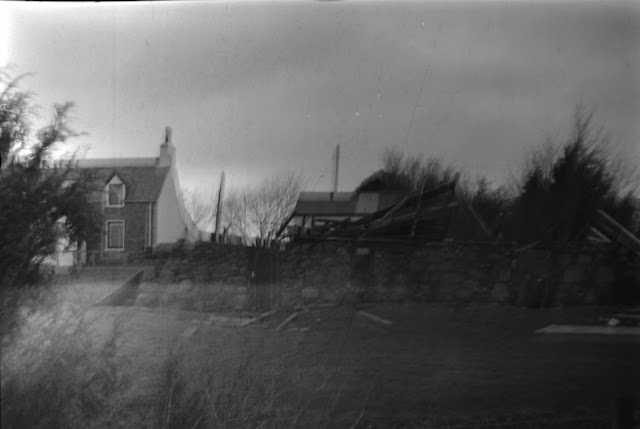
The first thing I learnt was that it is absolutely impossible to hold an eye-level box camera still when you are wearing a baby carrier. The only thing harder to keep still than the box camera is the baby. Still, this experiment produced some interesting motion blur shots that make the photos look a bit more like paintings.


On the next outing, daddy carried the baby so I was able to get a few sharp shots. Who knew you could use the Cupid for wildlife photography? Okay, so that small bird on the rock was actually quite a big Cormorant but I'm still quite pleased with the composition. Not having a telephoto lens, or a particularly fast one, I had to approach this bird shot completely differently to what I would normally do. I was actually pretty close to the bird when I took this. Thankfully, Cormorants don't move much when they're drying their feathers. Even so, I knew the bird would be tiny in the photo, so I could hardly claim it was the subject. Instead I treated it a bit more like artists do when they add a tiny person to a landscape they've just painted. A bit of interest that speaks about the grandeur of the surroundings.

Although the bird is miniscule in this image I think it really makes this photo. The image is neatly divided into three sections, shore, sea and sky. The stark contrast of that isolated rock against the sea immediately draws your attention, but it is the bird standing on it that keeps it there. Without the bird the rock is wholly unremarkable and the picture much less interesting. If the bird had been standing on any other rock it would have been lost against the background and we wouldn't have that pretty reflection. 

Anyway the upshot is, when presented with a scene you want to shoot, don/t curse having the wrong camera or lens. Embrace the limitation and use it to fuel your creativity. If I'd had my Om-2n and my 300mm Zuiko lens this would have been a close up of a Cormorant with very little surroundings. I wonder how many of those have been taken?

Tuesday, 21 April 2020

Pushing Catlabs Film with an Ensign Cupid

Today I shot another roll of Catlabs X Film 80, this time pushing it to ISO 200. I had another box camera that I hadn't tested yet so I thought I'd take it out and see what it can produce. The camera is a very early box camera made by Houghtons Ltd and couldn't be more different from the Ful-Vue. It is an Ensign Cupid, which was in production between 1922 and 1928.

The first thing you'll notice is that it isn't a box, in fact it has a very distinct T section. There is no glass viewfinder. Instead there is a huge fold-up frame finder with cross-hairs to assist with aim. Obviously this means you hold the camera at eye-level when shooting.

To cock the shutter you pull up the pin in front of the frame finder. There is a shutter lever to choose between Instantaneous and Time exposure and at the base of that is the shutter release button.

The achromatic lens helps to prevent aberrations. The camera shoots at roughly 1/40 at f/11. It's unique selling point, though, is that it shoots half frames so instead of 8 exposures you get 16.

So, naturally I was keen to see what this camera could do. It was shooting in the evening sun so I decided to push the film to 200 in development. The negatives were developed in HC110 (B) for 15 minutes. If you are curious about how to calculate timings for pushing or pulling film, check out my previous post, which has a link to a neat calculator created by my husband.

Here are the results:


So, for a camera that is nearly 100 years old I must say it's a delight to shoot and produces nice images. The lens stays remarkably sharp close to the edges and only gives a mild vignette. Clearly it also produces some impressive flare when pointed at the sun, though whether that is good or bad is personal preference. While the viewfinder looks comical I got pretty much everything I wanted in the frame, so it worked.

Pushing Catlabs to 200 worked nicely with these images.