Pages

All about box camera photography with a special emphasis on Ensign Ful-Vue cameras.
Showing posts with label Catlabs X film 80. Show all posts

Friday, 4 March 2022

First Cupid Outings: Motion Blur and Wildlife Photography

 In February I took the Cupid out on a couple of strolls around my village. Seeing as I want to work a lot with this camera this year I thought I better remind myself what its like to shoot out and about.

The first thing I learnt was that it is absolutely impossible to hold an eye-level box camera still when you are wearing a baby carrier. The only thing harder to keep still than the box camera is the baby. Still, this experiment produced some interesting motion blur shots that make the photos look a bit more like paintings.


On the next outing, daddy carried the baby so I was able to get a few sharp shots. Who knew you could use the Cupid for wildlife photography? Okay, so that small bird on the rock was actually quite a big Cormorant but I'm still quite pleased with the composition. Not having a telephoto lens, or a particularly fast one, I had to approach this bird shot completely differently to what I would normally do. I was actually pretty close to the bird when I took this. Thankfully, Cormorants don't move much when they're drying their feathers. Even so, I knew the bird would be tiny in the photo, so I could hardly claim it was the subject. Instead I treated it a bit more like artists do when they add a tiny person to a landscape they've just painted. A bit of interest that speaks about the grandeur of the surroundings.

Although the bird is miniscule in this image I think it really makes this photo. The image is neatly divided into three sections, shore, sea and sky. The stark contrast of that isolated rock against the sea immediately draws your attention, but it is the bird standing on it that keeps it there. Without the bird the rock is wholly unremarkable and the picture much less interesting. If the bird had been standing on any other rock it would have been lost against the background and we wouldn't have that pretty reflection. 

Anyway the upshot is, when presented with a scene you want to shoot, don/t curse having the wrong camera or lens. Embrace the limitation and use it to fuel your creativity. If I'd had my Om-2n and my 300mm Zuiko lens this would have been a close up of a Cormorant with very little surroundings. I wonder how many of those have been taken?

Monday, 26 April 2021

Another Eye-Level Box Camera: Kodak Brownie Cresta III

 I had a recent trip to Inverness and took with me another box camera, just in case there was anything nice to shoot while I was there.

After my failure with the Agfa Clack I decided to give another camera a go that is also shot at eye-level, a Kodak Brownie Cresta III. This plastic wonder may not look like much but it has one of the most reliable shutter mechanisms in my whole collection and its plastic Dakon lens gives lovely results. 

It dates from the first half of the 1960s and has a choice of two apertures, f/11 and f/16 (though these are labelled EV12 and EV13). It also has a close up lens that pulls into place with the lever on the side which allows you to focus as close as 4 feet. Its single shutter speed of 1/40 puts it on a par with the plastic Ensign Fulvueflex, another camera that many might dismiss as a toy but actually gives rather nice results.

As it happens, the weather was rather nice in Inverness and my husband and I had a hour before we had to move on, so we decided to take a walk along the Caledonian Canal. I am very happy to say that my pictures came out a lot sharper on the Brownie than they did on the Agfa, and most of the roll had some nice pictures on it.

One interesting thing did crop up, though. Apparently, at some point during lockdown, I loaded this camera in the vague hope of getting some nice shots near my home. I guess the conditions weren't great and I only managed to get 4 shots, after which I shelved the camera and awaited better conditions. I guess they were a long time coming because I couldn't remember for the life of me when I loaded the camera, or what film it was loaded with when it came to our Inverness outing. Peering through the film window revealed rounded numbers, which were a tell tale sign of Catlabs X Fiilm 80, a film I am very fond of. Now, either because the camera had been shelved for so long or because the film unravelled a little on loading, the first couple of shots had light leak. It probably happened during loading as I took the same shot of a sand castle three times, so I must have suspected the first frames wouldn't come out. The third shot was mostly unscathed and is pictured here:

Sand Castle

That's a surprising amount of detail in the sand from a plastic lens. 

Anyway, as I couldn't remember what the first 3 frames were, or the conditions in which they were taken, we decided to semi-stand develop the film, a process I will explain in more detail in the next post. For now, it will do to say that the film responded very well to this approach and we got some nice snaps.

Old Tractor Factory

Boats on the Caledonian Canal

More Boats on the Caledonian Canal

Swans

Bell Tower

Caledonian Canal

Wait For Me, Dad

Clachnaharry Railway

Railway Cottages

So we've ended up with some pretty vintage looking shots. I think C. T. Goode would have been very proud of my Clachnaharry Railway shot!

 I don't know how long the film sat in the camera but the sky shows some imprinting of the film backing paper on the image in many of the shots. I've had this happen before when a camera has sat loaded but unused for some time, so it's best to avoid that if possible. It hasn't ruined the shots though. Shall we just claim it adds character?

The Cresta III is a lovely camera. Highly recommended. A great box camera for beginners that's easy to use and doesn't involve any tricky waist level composing. British made Brownies are also good choices as they tend to take 120 film. Lots of other Brownie models take 127 film which is harder to come by and expensive.

Monday, 19 April 2021

Eye Level Box Camera: The Agfa Clack

Not all box cameras are shot at waist level. Some nice models are shot at eye level.
I have a couple in my collection and on the arrival of the recent lambing snows in my part of the world I thought it'd be nice to go out, play in the snow a bit and take some snaps with one of these machines. 

I'm pretty comfortable shooting at waist level now. I can usually do it without camera shake. Depending on the model of camera, and the size of its viewfinders I can more or less get a straight horizon too, though this is challenging on some, cough cough Junior Box Ensign. 

The eye level shooter I chose today was an Agfa Clack,which is a really lovely model with bells and whistles such as a swing in place close up lens with built in yellow filter, and two apertures, f/11 and f/12.5! It shoots eight 6x9 frames and has a 95mm meniscus lens. It's solidly made and feels nice to handle. In the right pair of hands it takes great shots.

Mine were not the right pair of hands today. I thought I was managing to keep the camera steady but the image blur shows I failed. The only image that was crisp, the last one, was also the only image I took in portrait instead of landscape. This suggests to me that my method of holding the camera up and pressing the shutter release with my right thumb was the problem, as when I held the camera differently for that one shot it remained steady. 

I can hardly review the camera with these shots. It would be grossly unfair. As the final, sharp shot demonstrates, the lens has some decent resolving power so I will have to learn from my mistakes and take this camera out again. It was still fun being out and about with a box camera, and I hope with time I'll get the hang of this one. 

I was shooting Catlabs X Film 80, pulled a stop to ISO 40 as the snowy conditions were so bright. The pictures are ordered from worst to best.

1) House and Boat
 

2) Fence Posts

 
3) Drunk Gate

4) Impressionist Power Poles


5) School Football Pitch


6) Road


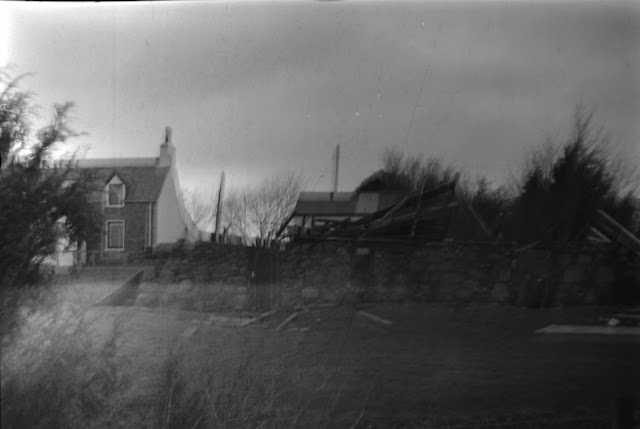
7) House Under Clouds


8) Stream
 

So some of those pictures will probably give you a headache if you stare at them too long. Others are blurry though I don't mind the results. I actually quite like the slightly impressionist vibes I get from the shot of the power poles, and I find the mild soft focus of the road shot quite pleasing. The image has a nice mood. I was very happy with the stream shot though. I think it gives a tantalising taste of what this camera can do. Let's hope I do better next time.

Monday, 12 April 2021

Testing the Halina 6-4

Well, it's safe to say that I haven't exactly been itching to go out with the box cameras during the Covid 19 pandemic. The travel restrictions meant that I'd have to shoot the same few miles around my home again and again which gets dull fast. The abysmal Winter weather didn't exactly lend itself to good box camera photography either, so many months have passed where all I've really done is keep the cameras dusted and wait for happier times.

The restrictions haven't lifted yet, but some of my as yet untested cameras have been staring me in the face, longing to be loaded and used again for the first time in who knows how long. This weekend I couldn't stand it any more, so I planned a brief excursion just a few minutes from home where hopefully there would be some nice seascapes and maybe some of the local livestock would be obliging and pose for some snaps. 

The camera of choice was a Halina 6-4, which, on the one hand is quite a swish box camera in that it has three apertures to choose from, double exposure interlock prevention, and shoots dual format, either 6x6 or 4x4. On the other hand the build quality is shocking, looking as though it was assembled as cheaply and quickly as possible. The edges are rough and the joins aren't exactly flush (particularly when you try and sit the 4x4 mask in place, it wobbles a bit, at least on my model), and you shudder as you place the film back on after loading because you strongly suspect it won't keep the film light tight. So, not exactly a precision model.

However, there is something about Halina cameras that make them an absolute joy to shoot. One of my favourite 35mm cameras is my Halina Paulette Electric. It wasn't exactly assembled with any love or care either but the experience of using it just puts a smile on your face. Maybe it's the knowledge that the camera isn't a laboratory standard precision instrument that needs treating with reverence and ceremony every time you raise it to your eye. Shooting the Halina feels so laid back and easy that you don't really think about buttons and dials and just think about the composition. One final point worth making is that while the camera bodies aren't exactly oozing quality, Halina did put good lenses in them, and the lenses are far more important. What this means is the cameras still take good pictures, and this is precisely what I found with the Halina 6-4. 

My husband gave the camera a quick dab of oil to get the focus ring moving as it should again and once we were satisfied the shutter was behaving itself I loaded it with some Catlabs X Film 80 and then we got togged up to go out. It may be late March but it was freezing outside and blowing a gale. Not exactly great shooting conditions but this was the afternoon I had scheduled for it, so out we went. 

There were a few challenges keeping the camera still in the wind. I typically just had to find somewhere sheltered or get low to the ground or wedge myself against some of the rock faces. I used the 4x4 mask to get 16 test shots and then we made our way home to huddle in front of the fire with a warm drink.

Predictably, the lighting conditions outside weren't favourable for the film's box speed, so we pushed the film in development to ISO 125. The camera had a fixed shutter speed of 1/50 and the widest aperture available (used in every shot) was f/8. We developed the film in HC110(B) for 11 minutes and 28 seconds, giving inversions every 45 seconds. 

Here are the results (well the good ones where the wind didn't move me and the camera).

Testing the portrait zone (5-10 feet)

Lockdown Fur

Testing the scenes zone (25 feet to infinity)

Hubby scrambling over the rocks.

I liked the swirl patterns in this rock face.

Wondering how much detail in the wood the lens would capture.

Rusty Old Submarine. Okay, it's actually a rusty old silo. One of my favourite test shots, again seeing how much detail the lens would capture.

Rocks and Waves. Another generic view testing the scene zone.

Some obliging cows smiling for the camera. By this stage I was freezing and just wanted a cuppa.
 

All in all, not bad. First surprise, the film back didn't allow any light leaks. As for the two-element lens, it performed quite well, especially in the portrait zone. The car tyre, old wooden stile, and submarine shot all have a lot of detail in them. I was super happy with the submarine shot. There was an impressive amount of detail in the metal and rivets, and the highlights on the grass were gorgeous. The scene shots were perfectly serviceable. The resolving power of the lens isn't amazing, so these 4x4 negatives won't enlarge all that successfully. Would they make nice contact prints? Yes. Bearing that in mind, would I shoot 6x6 next time? Probably. 

I will definitely take the Halina 6-4 on another outing. Shooting in a gale in overcast conditions wasn't exactly giving it a fair fight, but even so it performed respectably. I haven't tried the smaller apertures yet, so the sharpness may well improve when shooting scenes at f/11 or f/16.

Another fun Halina camera and one I can recommend if you want a box camera with a little more choice when it comes to apertures. If you are considering this camera because you like the idea of shooting 4x4 just make sure you ask the seller if the mask is included. It detaches from the camera and is easily lost.


Wednesday, 6 May 2020

Double Exposures on the Fulvueflex Synchroflash

I had one roll of Catlabs X Film 80 left so I decided to have some fun and give some double exposures a try. I'd never taken double exposures before (not intentionally anyway) but I knew the basics. The second image will show up most obviously on the dark areas of the first image. Normally one would underexpose each image by one stop to make sure the final image is correctly exposed. Of course, with box cameras there's no adjusting the settings, so you have to do this in development.

There is an art to taking good double exposures. One of the most helpful demonstrations I've seen is this video by Eduardo Pavez Goye, so definitely check that out if you're interested in giving it a try.

I think I need a bit more practice yet, but these were some of the better results. In the end I pulled these shots to ISO 50 and developed them in HC110(B) for 7:50 minutes at 20°C.

Bath tub in the rushes


Beware


Extra secure storage


Portrait of my husband


Ghost boat


Beached

So, that was fun! After shooting 10 rolls of Catlabs film I'll definitely buy more. The results have been great and I think I can call my experiment a success. You can load a box camera with the same speed film in all different lighting conditions and then compensate in development. I pulled the film to ISO 50 and pushed it as far as ISO 640 and got great pictures. There are probably other film stocks that are just as versatile. I wanted to give Catlabs a go because I'd never shot it before. Like I've commented before, the grain is very fine, the latitude is impressive and the film is super versatile in development so overall very happy with the results.


Monday, 27 April 2020

Testing a Junior Box Ensign


While I've been experimenting with Catlabs film, I have added a new box camera
to the collection. This is the Junior Box Ensign, which predates the first Ful-Vue by about a decade. They were made between 1929 and 1933 and there are two striking differences from the Ful-Vue range. First, the camera is much bigger, particularly taller. This is because there is no inner cone for film loading. Instead, the take-up and loading spools sit above and beneath the film plane respectively.

The other obvious difference is the viewfinder. The Ful-Vue finder is huge. The Junior Box has two finders and each is miniscule. The one on top is for vertical shots and the one on the side is for horizontal shots, just like the Ferrania Zeta Duplex I tested not long ago. I thought composing on the Ferrania was hard. This was harder. No wonder the Ful-Vues were so popular.

There were no details in the camera's literature regarding its aperture or shutter speed. In the end my husband and I made an educated guess at f/12.5 and 1/40. Judging from the results we were about right. The lens does not focus closer than 10 feet.

I ran a roll of Catlabs X Film 80 through the camera. I had a wonky horizon on nearly every shot. Interestingly I also ended up with a lot more sky than I intended with some of them. The subjects were so tiny it was hard to know at times if I was even pointing at the right thing.

Another quirk of this camera is that the shutter fires when you push the lever in either direction, which took some getting used to. 

Anyway, I ended up with eight 6x9 exposures and although the compositions of some are questionable due to photographer error, the lens performed well, producing a minimal vignette. The images aren't tack sharp of course, but the vintage character of the lens is nice.

Here are some of the results:

A nice rural scene


More sky than I wanted, but still a nice capture. The horizon was straightened a little afterwards.


My favourite shot, though still not straight.


It nicely captured this moody scene.


A ridiculous amount of sky. I must have tilted the camera a fraction before shooting.


So, more practice required with the Junior Box Ensign. A nice camera though. Because it is so big it's easy to steady so there is less chance of camera shake. I was a bit worried the shutter lever might get nudged in my bag as I was walking, but there were no accidental exposures.

During production this camera was a budget model available for 8s 6d. It was also available through premium schemes in return for tokens, and would arrive with a roll of film. I think I'd have been delighted with it, once I got the hang of those tiny viewfinders of course.


Sunday, 26 April 2020

Pushing Catlabs to 640


Having had good results pushing Catlabs X Film 80 all the way to 320, I decided to try my luck one stop further at 640. I loaded up the Ful-Vue model II and waited for the sun to start setting. When it was low enough I ventured out to my usual spots for test shots and returned with 12 exposed frames. I developed the film in Rodinal 1+25 at 24°C for 30 minutes. I had absolutely no idea what to expect. I didn't know if the development would work or if the pictures would all be horribly underexposed.


Here are the results:


Modus - The shiniest my car has ever looked - lens set for close-ups


Backlit Daffodils - very happy with how this came out - lens set for close-ups.


Firemore Beach and Cable Hut


Loch Ewe


Jetty - with lens flare


Cave


Looking out to sea - light was getting pretty low by now


Trees - A little underexposed but still nice


Cottage


The Torridons


Gate Post - lens set for close-ups


Another view of the Torridons

So, once again, pretty impressed. That little meniscus lens produced some nice sharp images, especially of my car and the gate post. The Catlabs film handled pushing this far just fine.