Pages

All about box camera photography with a special emphasis on Ensign Ful-Vue cameras.
Showing posts with label Ful-Vue I. Show all posts

Friday, 17 April 2020

Pulling Catlabs X Film 80

My first test shots with Catlabs film were on a miserable and overcast day. This
next batch of test shots were taken on one of the brightest days we've had so far this year. The light conditions were at the higher end of EV13, pushing close to EV14. This was a great opportunity to try pulling the film to 50 ISO, so I loaded up the early model Ful-Vue and went out shooting.

If you search pushing/pulling film online you'll find far more results for pushing film. There are some firmer guidelines around pushing, whereas pulling is more of a dark art. After much searching I found a forum where a contributor stated for every stop pulled you should subtract 10% from the development time. After more searching I found another forum and someone else stating it should be 20%.

I decided to settle in the middle at 15%. Pulling from ISO 80 to 50 is only 2/3 of a stop, so I needed to reduce my development time by 10% (15% for whole stops, divided by 3 = 5% for 1/3 of a stop, and 5% x 2 =10% for the 2/3 of a stop). The standard development time for Catlabs rated at 80 ISO in HC110 developer is 8:45 minutes. Maths is not my strong point, whereas my husband finds sums on this level entirely trivial. So, on the off chance you struggle with this sort of thing too, I've asked him to explain how to work out the reduced development time here:

...Nicky explains with simple words
So having worked out that we need to reduce time by 10% we do some trifling simple maths and say that 8:45 becomes about 7:50. Bosh. Done. Pint time. What do you mean you want the details... Oh, fine, here they are.

100% of time is 8:45, now that's all well and good but we need it in decimal form to do maths, so divide the seconds by 60 to get decimal minutes: 45/60 = 0.75 minutes. Add the 8 back on and voila, 8.75 minutes.
Ok, now to reduce by 10%: 100% - 10% = 90% (yeah, that is easy, but now for the part surprisingly few people get) % means percent, which means divide by 100. So lets divide 90 by 100 and hey ho, its 0.9. Now for the next bit that trips people up: Multiply the 8.75 by 0.9 and we get 7.875. What has magically happened here is we have used multiplication to carry out a subtraction. Boom, minds blown, yeah, I know.
Righty, now we have a useless decimal number of minutes because our timer works in minutes and seconds. So we need to know how many seconds to set it for. Just do the decimal conversion backwards. Subtract off the 7 whole minutes part to leave the 0.875 minutes part. Multiply that by 60 seconds and get 52.5 seconds. Now this is a fiddly number of seconds so we will call it 50 seconds. Add the 7 whole minutes back on to get 7:50. Right, now is it pint time? No? What do you mean I cheated you out of 2.5 seconds... No one cares about those, this is an analogue process and most analogue things are normally within a tolerance of ±50%. Plus it'll take far longer than that to pour the chemicals in and out. Anyway, pint time.


Thank you Nicky. Since then Nicky made this handy calculator to do the maths bit for you.

So, I developed the film for 7:50 minutes. Here are the results. Although conditions were very bright, they were also very hazy, so I tried to focus on close-ups and keep the sky and far distance out of the photos. Where that wasn't possible I used a yellow filter to cut through some of the haze.

Bad Hair Day. Taken with the lens pulled out for close-ups. This creates a strong vignette.
Old Chimney.


Fence Post - Again taken with the lens pulled out, creating a strong vignette

Tree. Taken with a yellow filter.

Lisa Jane.

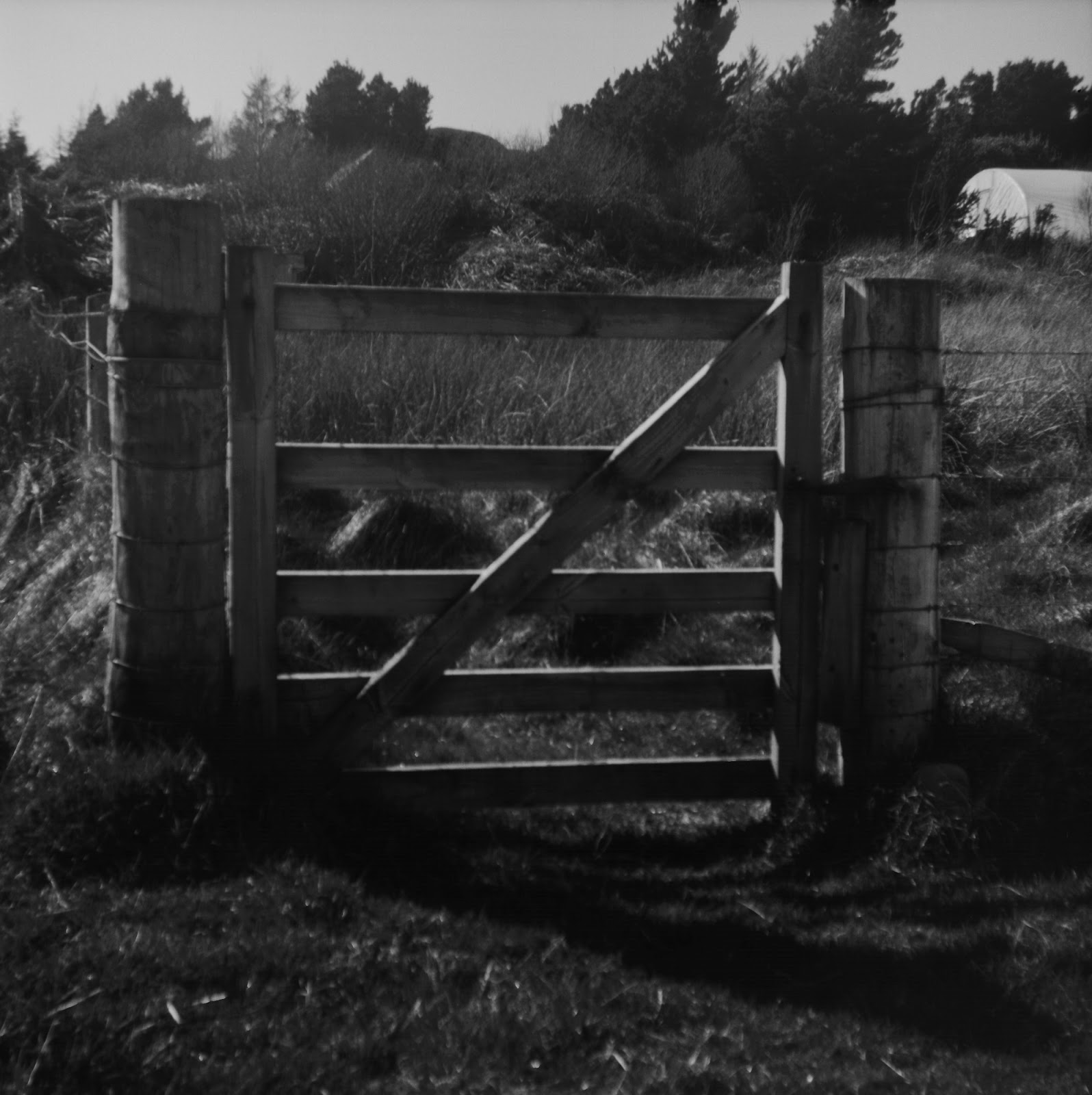
Gate


Shore Path. Taken with a yellow filter.


Staggered Fences. Taken with a yellow filter.


Ruins


Garden Shed (also featuring cameo of Tree). Taken with a yellow filter.


Friendly Horse. Taken with lens pulled out.


Old Bench.

I'm really happy with the results. The film works well pulled to ISO 50. I'm also delighted with how the Ful-Vue performed. Looking forward to more experimenting with Catlabs film.


Saturday, 19 October 2019

Box Cameras and Wedding Snaps

Captured on the Kodak Brownie Cresta III, Fuji Pro 400H
A few weeks ago my partner and I got married in a beautiful ceremony at the Royal Botanic Gardens in Edinburgh. Instead of the usual photo-booth option for the wedding guests, we decided we'd share our passion for vintage cameras and set up a box camera station, where guests could use box cameras to take snapshots of the day. It went down a storm. The novelty of shooting film again would certainly have been a memorable part of the day, and the best part was uploading the images a few weeks later for all to see their handy work.

It was impossible to predict  beforehand what sort of weather and lighting conditions we'd have, so we just went for ISO 400, one of the more versatile films that can handle most conditions. We had a mix of Fuji Pro 400H and Lomography 400, and both performed well.


Garden snaps, captured on the Kodak Brownie Cresta III, Fuji Pro 400H


Most of the wedding guests hadn't shot a film camera for a very long time, and for many a waist level viewfinder was totally new territory. For the most part the pictures came out well. There were one or two instances where people forgot to wind on, resulting in some interesting double and triple exposures. Nevertheless, we have some lovely snapshots to remember the day. The cameras used were:
Ful-Vues model 1, 1.5, 2, and Fulvueflex Synchroflash, Kodak Brownie Cresta III, Ilford Envoy, and an Agfa Clack. 

Here are some of the results.

Captured on the Ensign Fulvueflex Synchroflash, Lomography 400.

Captured on the model 1 Ensign Ful-Vue, Fuji Pro 400H


Triple Exposure, captured on the Ensign Fulvueflex Synchroflash, Lomography 400

Double exposure, captured on the model 1 Ensign Ful-Vue, Fuji Pro 400H

Double exposure, captured on the model 1 Ensign Ful-Vue, Fuji Pro 400H
Captured on the model 1 Ensign Ful-Vue, Fuji Pro 400H

Captured on the Kodak Brownie Cresta III, Fuji Pro 400H
Captured on the Ensign Fulvueflex Synchroflash, Lomography 400

Captured on the Kodak Brownie Cresta III, Fuji Pro 400H

Captured on the Ensign Fulvueflex Synchroflash, Lomography 400

Friday, 5 April 2019

1939 Advert for the Ful-Vue

I saw these adverts, which are just newspaper cuttings, on eBay and couldn't resist. I think they're fantastic. Be sure of getting 12 perfect pictures from every roll eh? Well the pics on my first test shoot weren't all perfect, but that was down to photographer error. Hands not steady enough and one accidental double exposure! At least no one lost their head. See if I do better next time.


Saturday, 9 March 2019

Full-Vue Portrait - test shot


This photo was taken on the Ful-Vue (model 1) on Kodak Ektar 100 film. The result is quite nice and sharp with some vignetting around the edges. Certainly better than I expected. To take a portrait on this camera you need to pull the lens out to its 'portrait' setting. Will definitely try this again.

Monday, 23 April 2018

Tuesday, 19 July 2016

How was the Ful-Vue camera different?

Ful-Vue Viewfinder

A few Ensign box cameras pre-date the Ful-Vue, such as the Ensign ‘Box-Form’, the ‘All-Distance’, and the ‘E29′. 
The Box-Form cameras are listed in the Ensign Handbook of Photography (c.1908), which gives the following description:

“The Box-Form Ensign Film Cameras are exceptionally well and strongly made. They give excellent sharp-all-over pictures.  There is nothing to go wrong, and their absolute simplicity makes success certain.” p.36
The Ensign Box-Form 2 ¼ B had an f/11 rapid achromat lens (variants had a meniscus lens), two reflecting viewfinders and a frame finder.
The All-Distance Ensign was introduced in 1927.  It had a meniscus “all-distance” lens, simple T and I shutter settings, two brilliant viewfinders and a frame finder, and a tripod socket.  Models in blue, red, and brown were introduced in c.1929.  In the accompanying manual, Instructions for Using the All-Distance Ensign Camera, it states:

“There are two outstanding features…The All-Distance Ensign Camera, as its name implies, permits of brilliant sharp pictures being taken at all distances in excess of 3 ½ feet from the camera (WITHOUT THE NECESSITY OF PURCHASING A SUPPLEMENTARY PORTRAIT ATTACHMENT).
Second - By a specially designed (Prov. Pat. 27103) internal spring pressure plate the film is held perfectly flat and thus the definition is as good as will be obtained with a glass plate.” p. 2-3
The Ensign E29 Box Camera (c.1930) was a wooden bodied camera finished in black or blue leatherette, with a simple T and I shutter, a meniscus lens and two reflecting viewfinders.  Close-up lenses were available as accessories.
So what about the Ful-Vue?  How did it differ from these earlier models?
Its main selling point was undoubtedly its large viewfinder (pictured).  A glance at newspaper adverts from the time of its release reveal as much.  On 24th March 1939, the Kent & Sussex Courier featured the following announcement:

“The New British Made Ensign “FUL-VUE” Camera takes 12 pictures 2 ¼ square on the usual No. 20 film, has specially brilliant new view finder so that picture can be clearly seen under all conditions.  Adaptable for Views and portraits and fitted with the Time and Instantaneous Shutter.  With a sling strap 25/-” p. 7
The same newspaper featured another advert on 12th May 1939:

“See your Picture at a glance…
Ensign FUL-VUE the CAMERA with the GIANT VIEW-FINDER
Taking good pictures is simpler and certain with the Ensign ‘Ful-Vue’ - the ideal camera for the beginner and the keen amateur.  CLOSE UPS AND DISTANCE VIEWS with the famous Ensign ‘ALL-DISTANCE’ LENS.
Takes 12 pictures 2 1/4x 2 ¼ in. on Ensign standard size E.20 film.
Get an Ensign ‘Ful-Vue’ to-day! Andalways use Ensign Film.  Only 25/-
BRITISH THROUGHOUT” p.7
Chemists were among the primary retailers of cameras at the time, so it was important for manufacturers to convince chemists that their cameras would sell well.  Ful-Vue adverts therefore appeared in issues of The Chemist and Druggist. Such an advert featured on the 4th February 1939:

“NEW ENSIGN BOX CAMERA - Ensign Ltd, 88-89 High Holborn, London, WC1, have introduced a new box camera which is described as the Ful-Vue, the main feature of which being the bigger, brighter and better viewfinder.  This model is very compact, measuring only 4 1/8 by 3 1/8 by 4 1/8 in.  It has an excellent finish in black ripple enamel, and it takes close-ups down to three feet.  In adition, it is economical to use, taking twelve 2 ¼ in. square pictures.  Stocks are available for immediate delivery.” p.122
It appeared again in the same publication on 1st April 1939:

“ENSIGN FUL-VUE CAMERA - A newly introduced box camera that bids fair to achieve a widespread popularity is the Ful-Vue  brought out by Ensign Ltd, Ensign House, High Holborn, London, WC1.  The important feature of this is a super-size, waist-level brilliant viewfinder giving an image 1 ½ in. square.   The camera, which is of metal construction, with all-distance lens is in two-position focusing mount, and time and instantaneous shutter, is designed to take twelve pictures (size 2 ¼ in. by 2 ¼ in.) on a standard 20 film.  Numbering of the exposures is viewed through  a centrally-placed ruby window in the back of the camera, and thus the camera requires no re-numbering device as on certain other models of the twin-lens type.”  p.382
Another advert appeared in the Sunday Mirror on 25th February 1945 and refers to the impact the war had had on Ensign in diverting its manufacturing efforts to the war effort:

“The easiest camera to use in the World is this popular Ensign Ful-Vue Model with its unique Picture size brilliant viewfinder.  When the skill now employed upon the manufacture of Aircraft cameras and similar precision instruments for the Services is available, the Ensign Ful-Vue will be even better, for like all Ensign Cameras the post-War models will incorporate the great advances made by Ensign in Optical Technique and precision Engineering.” p.5